Top 5 Programming Languages to learn in 2026
Introduction: The Confession of a Senior Engineer
I have a confession to make. For years, I was wrong.
I was wrong because I fell into the trap that many content creators and tech leads fall into: the trap of the linear roadmap. I used to make content that prescribed a rigid path: “Learn Language A first, then Language B, then Framework C.” It was neat, it was clickable, and it was fundamentally flawed.
In the real world of software engineering, specifically as we approach 2026, blindly listing programming languages in decreasing order of preference is a disservice to the craft. No technology is inherently “useless.” Every tool in our stack exists because it solved a specific problem at a specific time better than its predecessors.
If you are reading a blog or watching a video that lists languages at Number 1, 2, and 3, you must ask: What is the basis for this ranking?
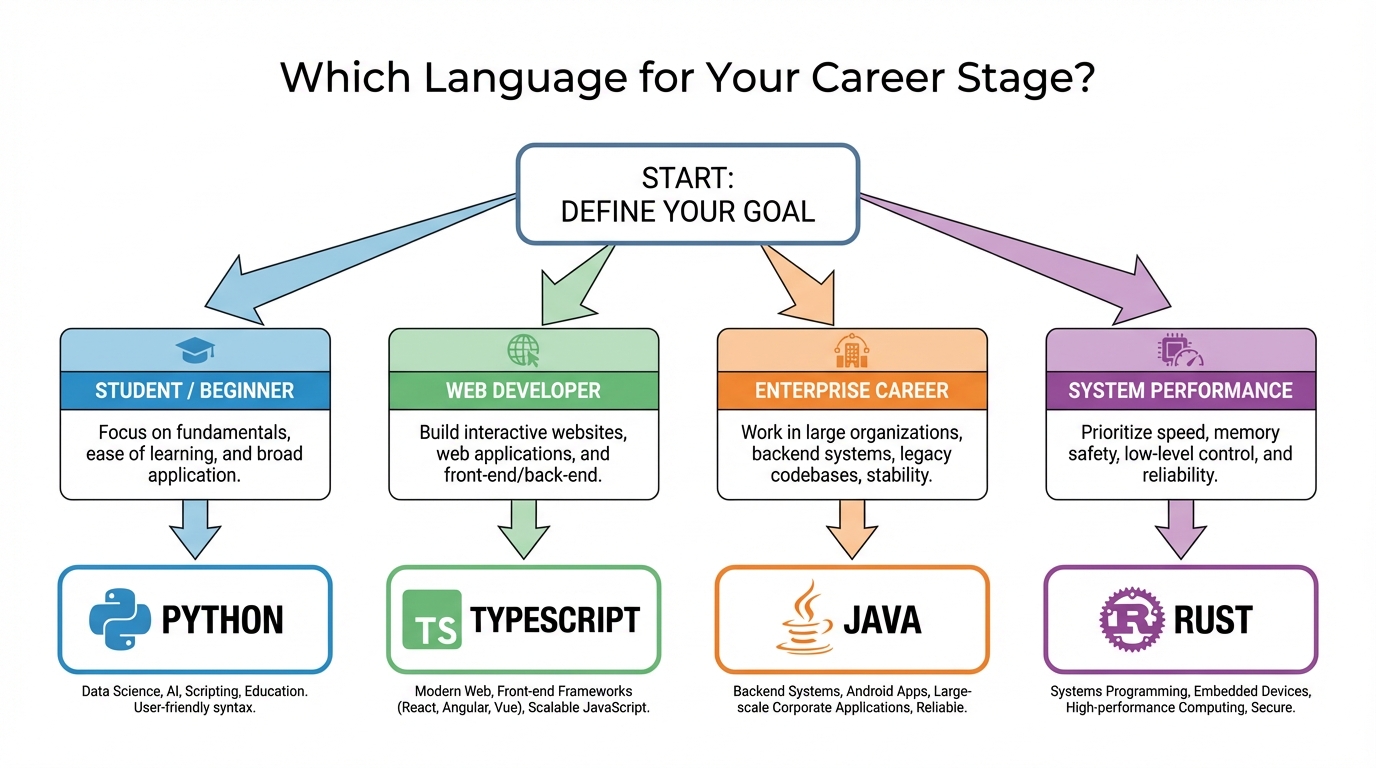
The reality is that the “best” language depends entirely on your context:
- Are you a student? You need foundational strength (Memory management, DSA).
- Are you a working professional? You need scalability and ecosystem support.
- Are you pivoting from non-tech? You need accessibility and rapid feedback loops.
If I simply gave you a list—1, 2, 3, 4, 5—without this context, this article would be meaningless.
Why This Deep Dive Exists
So, why am I writing this extensively now? The reason is the overwhelming volume of requests regarding the roadmap for 2026. “Harry Bhai, what should I learn to stay relevant?”
My job is to guide you, not just to feed you syntax. In this deep dive, the order I share is not a ranking of quality, but a ranking of strategic opportunity based on where you are in your life. Time is your scarcest resource. You can earn unlimited money as a developer, but you cannot reclaim the time spent learning a dying stack or a language that doesn’t align with your career goals.
The Methodology: Data-Driven Decisions
We are engineers; we trust data, not hype. To compile this analysis for 2026, I didn’t rely on gut feeling. I aggregated insights from three primary pillars of truth in our industry:
- The Stack Overflow Developer Survey: For understanding developer sentiment and daily usage.
- The GitHub Octoverse Data: For analyzing actual code being pushed, PRs merged, and open-source velocity.
- The TIOBE Index: For long-term historical trends and industry stability.
Let’s dive into the technical architectures, trade-offs, and code-level realities of the top 5 languages for 2026.
1. Python: The API of the AI Revolution
The Context
Python is the first language on this list, and for 2026, it is arguably the most critical for career velocity.
Who is this for?
- Beginners: It reads like English, abstracting away memory management.
- Intermediates/Career Switchers: If you are moving into Data Analytics or Data Science, this is non-negotiable.
- Experts: It is the glue code of the internet and the interface for high-performance computing (HPC) via C-extensions.
The Data
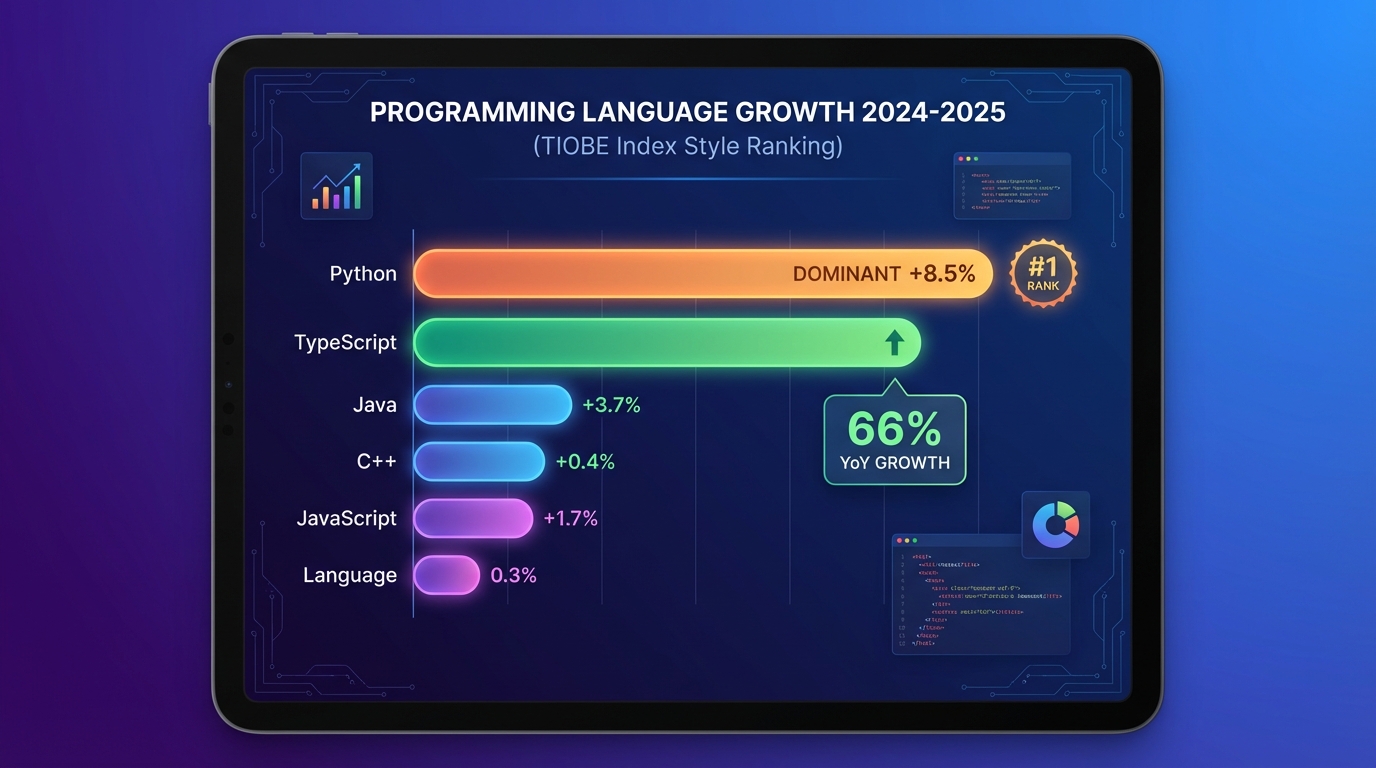
- TIOBE Index (Nov 2025): #1. Python has held the “Language of the Year” title repeatedly (2007, 2010, 2018, 2020, 2021, 2024).
- Stack Overflow (2025): 57.9% of respondents use Python, a massive 7% jump from 2024, driven entirely by the AI boom.
- GitHub Octoverse: In 2024, Python officially overtook JavaScript as the most popular language on the platform.
Technical Deep Dive: Why Python?
Many critics argue that Python is “slow” because of the Global Interpreter Lock (GIL) and its interpreted nature. While technically true for pure Python code, this argument misses the architectural reality of modern Python.
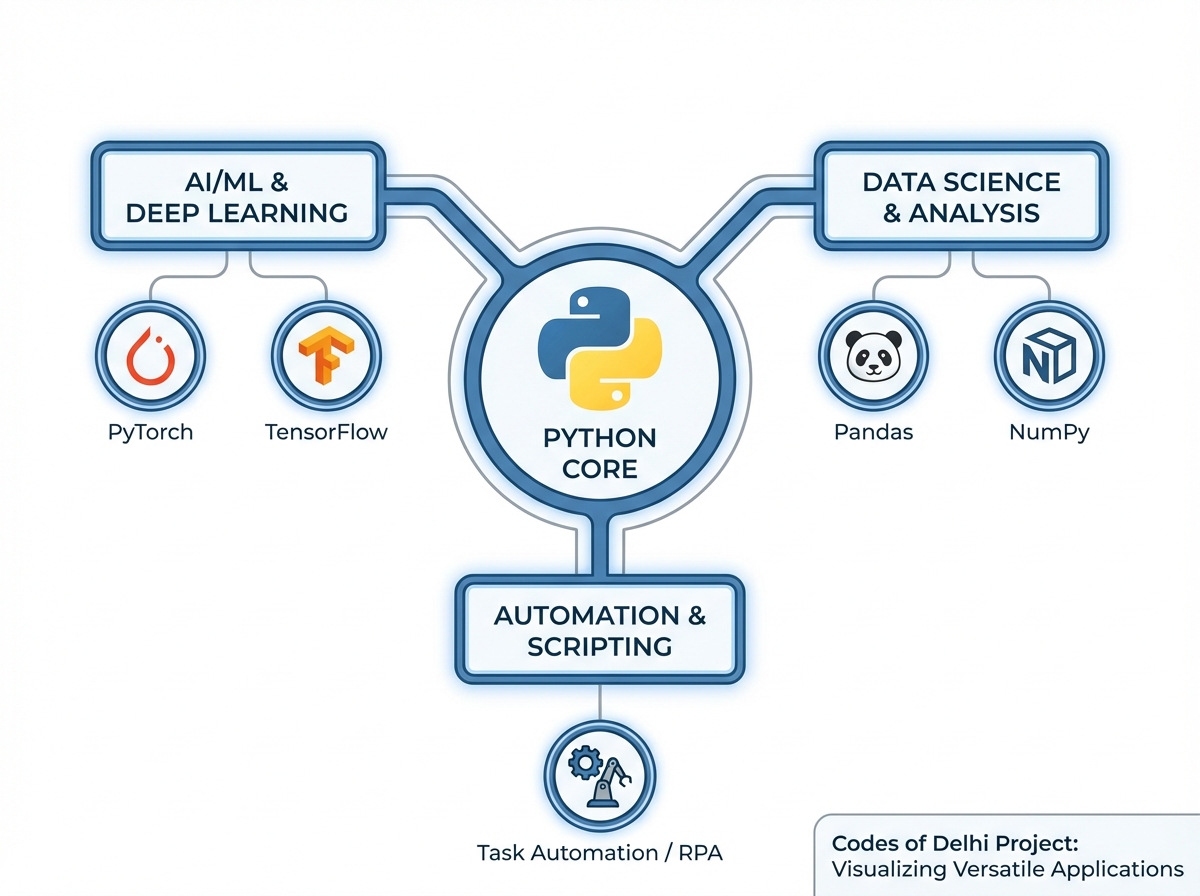
Python is rarely used for raw computation in production; it is used as an interface. When you run a heavy workload in Python (like training an LLM or processing a Petabyte of data), Python is merely dispatching instructions to highly optimized C/C++ or CUDA kernels.
Architecture: The C-Extension Ecosystem
Libraries like NumPy, PyTorch, and TensorFlow are written in C and C++. Python provides the high-level syntax to manipulate these low-level memory structures.
Consider the recent updates to my Data Science course. We are running OpenAI’s Whisper model. You aren’t writing the matrix multiplication algorithms in Python loops; you are calling a compiled binary.
Code Example: Running Whisper Inference Here is how simple it is to leverage State-of-the-Art (SOTA) AI, hiding massive complexity behind a clean Python API.
import torch
from transformers import AutoModelForSpeechSeq2Seq, AutoProcessor, pipeline

# 1. Device Agnosticism: Check for GPU (CUDA), Mac (MPS), or CPU
device = "cuda:0" if torch.cuda.is_available() else "mps" if torch.backends.mps.is_available() else "cpu"
torch_dtype = torch.float16 if torch.cuda.is_available() else torch.float32

model_id = "openai/whisper-large-v3"

# 2. Load the Pre-trained Model (Optimized C++ backend)
model = AutoModelForSpeechSeq2Seq.from_pretrained(
    model_id, torch_dtype=torch_dtype, low_cpu_mem_usage=True, use_safetensors=True
)
model.to(device)

processor = AutoProcessor.from_pretrained(model_id)

# 3. Create the Inference Pipeline
pipe = pipeline(
    "automatic-speech-recognition",
    model=model,
    tokenizer=processor.tokenizer,
    feature_extractor=processor.feature_extractor,
    max_new_tokens=128,
    chunk_length_s=30,
    batch_size=16,
    torch_dtype=torch_dtype,
    device=device,
)

# 4. Execute
# This single line triggers massive parallel computation on the GPU
result = pipe("audio_sample.mp3")
print(f"Transcribed Text: {result['text']}")
Career & Salary
In India, Python developers in the Data Science/AI domain command between 13 LPA to 26 LPA on average.
The Warning: If you are a first-year student and your curriculum focuses on C/C++, do not ignore it for Python. Python makes you lazy with memory. C++ teaches you how the computer actually works. Learn Python on the side, but master your foundations first.
2. TypeScript: The Savior of Scale
The Context
At number two, we have TypeScript.
Who is this for?
- Web Developers: If you know JavaScript, you must migrate to TypeScript.
- Full Stack Engineers: Essential for Next.js, React, and Node.js environments.
The Data
- GitHub Octoverse 2025: TypeScript is #1 in terms of growth context.
- Growth Rate: 66% Year-on-Year growth vs Python’s 48%.
- Adoption: It has become the “Recruiter’s Choice.”
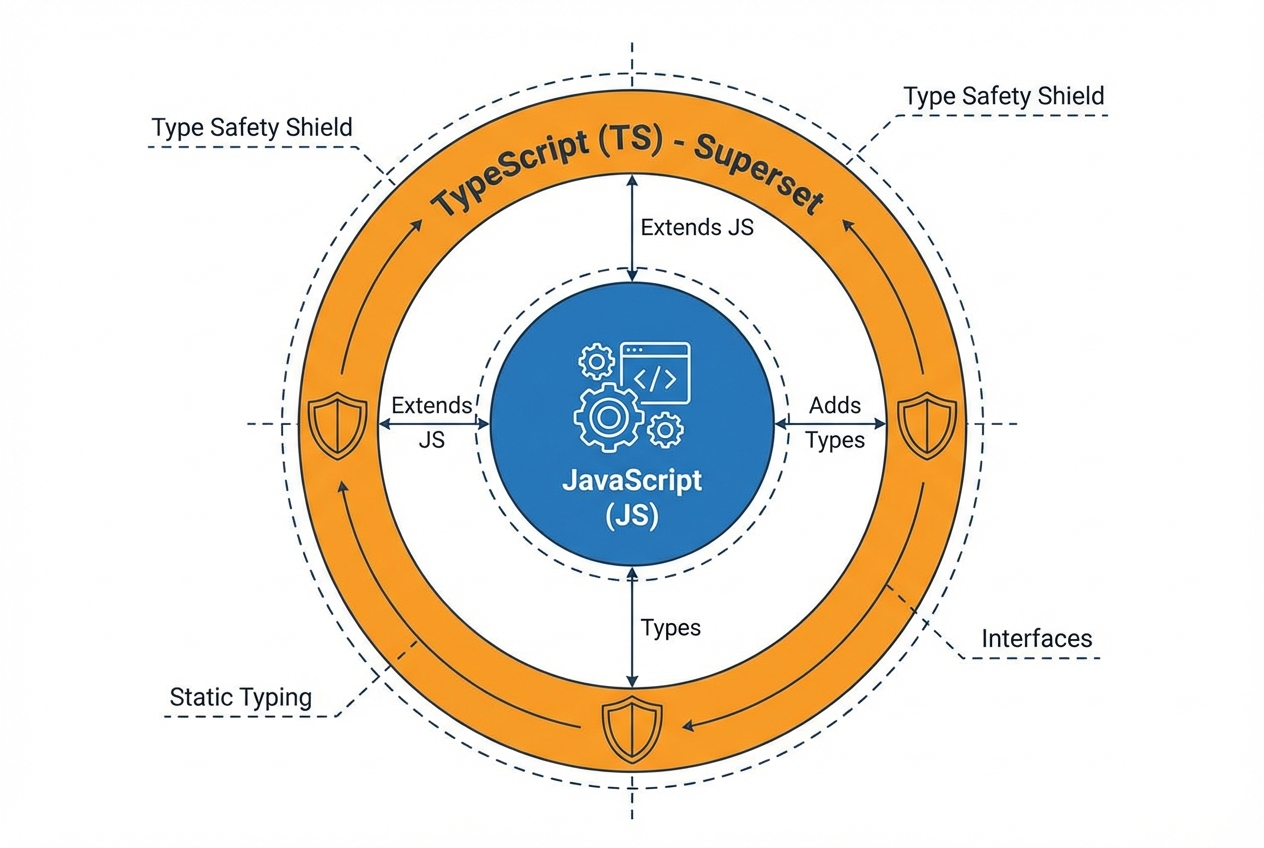
Technical Deep Dive: Static Typing in a Dynamic World
JavaScript is loosely typed. This is great for prototyping but catastrophic for large-scale applications. A variable user can be an object today, a string tomorrow, and undefined on Friday evening production deploys.
TypeScript introduces Structural Typing. Unlike Java’s nominal typing (where the name of the class matters), TypeScript cares about the shape of the object. It compiles down to JavaScript, meaning it adds zero runtime overhead—all checks happen at build time.
The Problem: “undefined is not a function”
In 2026, shipping code without type safety is considered professional negligence in top-tier tech companies.
Code Example: Interfaces and Generics Here is how TypeScript prevents an entire class of bugs that plague JavaScript developers.
// Defining the Shape of Data
interface User {
  id: number;
  username: string;
  email: string;
  role: 'admin' | 'editor' | 'viewer'; // Union types
  meta?: Record<string, unknown>; // Optional metadata
}

// Generic Response Wrapper
interface ApiResponse<T> {
  data: T;
  status: number;
  timestamp: string;
}

// Function with strict type enforcement
async function fetchUser(userId: number): Promise<ApiResponse<User>> {
  // Simulate DB call
  const user = await database.users.findUnique({ where: { id: userId } });

  if (!user) {
    throw new Error("User not found");
  }

  // TypeScript will error here if 'user' doesn't match the 'User' interface
  return {
    data: user,
    status: 200,
    timestamp: new Date().toISOString()
  };
}

// Usage
const result = await fetchUser(101);

// SAFTEY: TypeScript knows 'result.data.role' exists.
// It also knows 'result.data.password' DOES NOT exist.
if (result.data.role === 'admin') {
    console.log("Access Granted");
}
Career & Salary
For React/Next.js developers in India, the average salary ranges from 10 LPA to 30 LPA. Senior developers architecting large frontend systems with strict TypeScript configurations can easily surpass 40 LPA.
3. C and C++: The Timeless Foundation
The Context
At number three, we return to the metal.
Who is this for?
- Students: This is non-negotiable for building a mental model of computing.
- System Programmers: Game engines, High-Frequency Trading (HFT), Embedded Systems.
The Data
- TIOBE Index: Consistently #2 and #3.
- GitHub Octoverse: C grew 20% YoY; C++ grew 11.8%.
- Use Case: The AI libraries mentioned in the Python section (NumPy, TensorFlow) are all maintained by C++ engineers.
Technical Deep Dive: Manual Memory Mastery
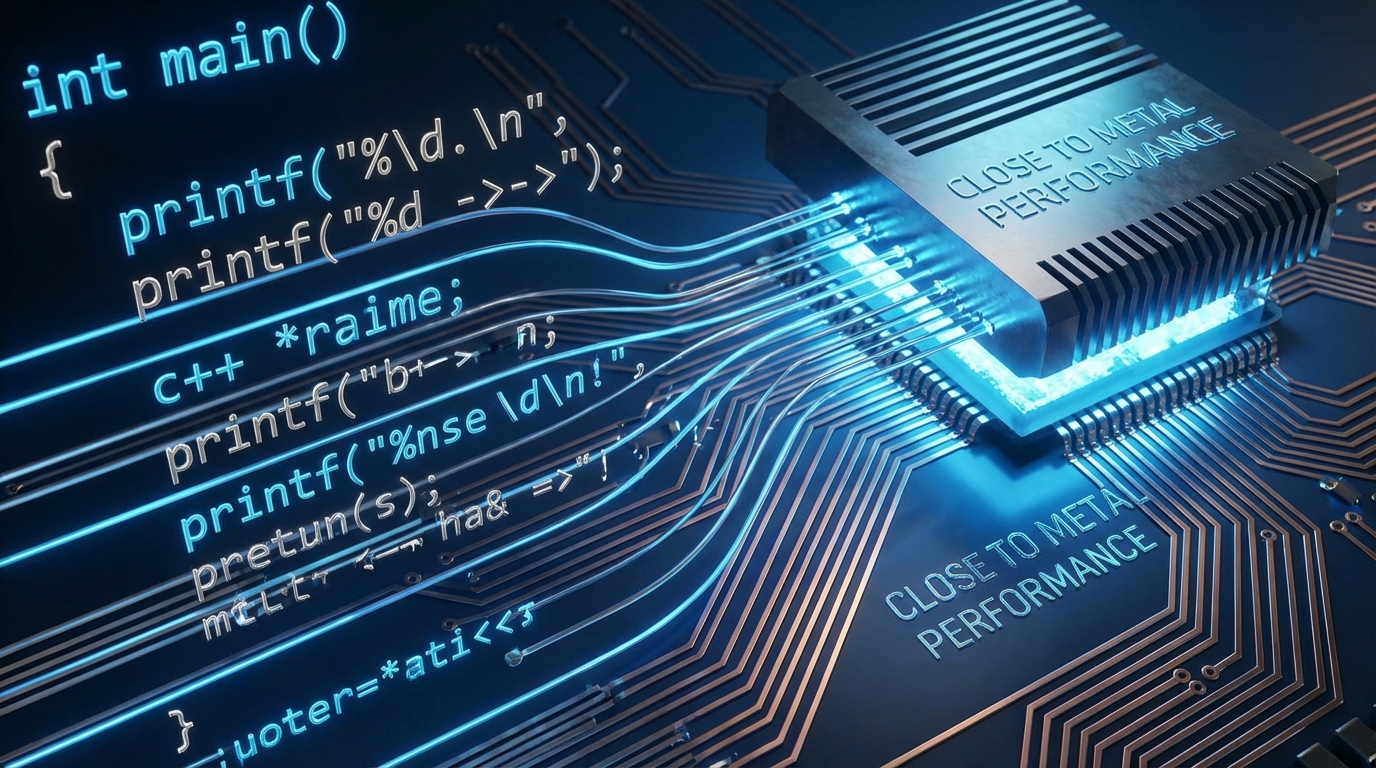
Why is C++ still growing in 2026? Performance per watt and predictability. In languages like Java or Python, a Garbage Collector (GC) runs periodically to clean up memory. This causes “stop-the-world” pauses. In HFT or Real-Time systems (like self-driving cars), a 50ms GC pause causes a crash or a financial loss.
C++ gives you RAII (Resource Acquisition Is Initialization) and Smart Pointers, allowing for deterministic memory management without the GC overhead.
Code Example: Modern C++ (C++20) & Memory Management
Notice how we use std::unique_ptr to handle memory automatically (when it goes out of scope) without a garbage collector.
#include <iostream>
#include <vector>
#include <memory>
#include <algorithm>

class MatrixEngine {
    int rows, cols;
    std::vector<double> data;

public:
    MatrixEngine(int r, int c) : rows(r), cols(c) {
        data.resize(r * c, 0.0);
        std::cout << "Matrix initialized on Heap" << std::endl;
    }

    ~MatrixEngine() {
        std::cout << "Matrix destroyed (Memory Freed)" << std::endl;
    }

    void compute() {
        // Simulating heavy computation
        std::transform(data.begin(), data.end(), data.begin(), [](double d) {
            return d + 1.0;
        });
    }
};

int main() {
    // Smart Pointer: Automatically manages lifecycle
    // No 'new' or 'delete' keywords needed here.
    std::unique_ptr<MatrixEngine> engine = std::make_unique<MatrixEngine>(1000, 1000);

    engine->compute();

    std::cout << "Computation Complete" << std::endl;

    // 'engine' goes out of scope here.
    // The destructor is called immediately and deterministically.
    return 0;
}
Advice
If you are in college, obsess over C++. If you understand Pointers, Stack vs. Heap, and Pass-by-Reference, learning any other language (Java, JS, Python) becomes trivial.
4. Java: The Enterprise Monarch
The Context
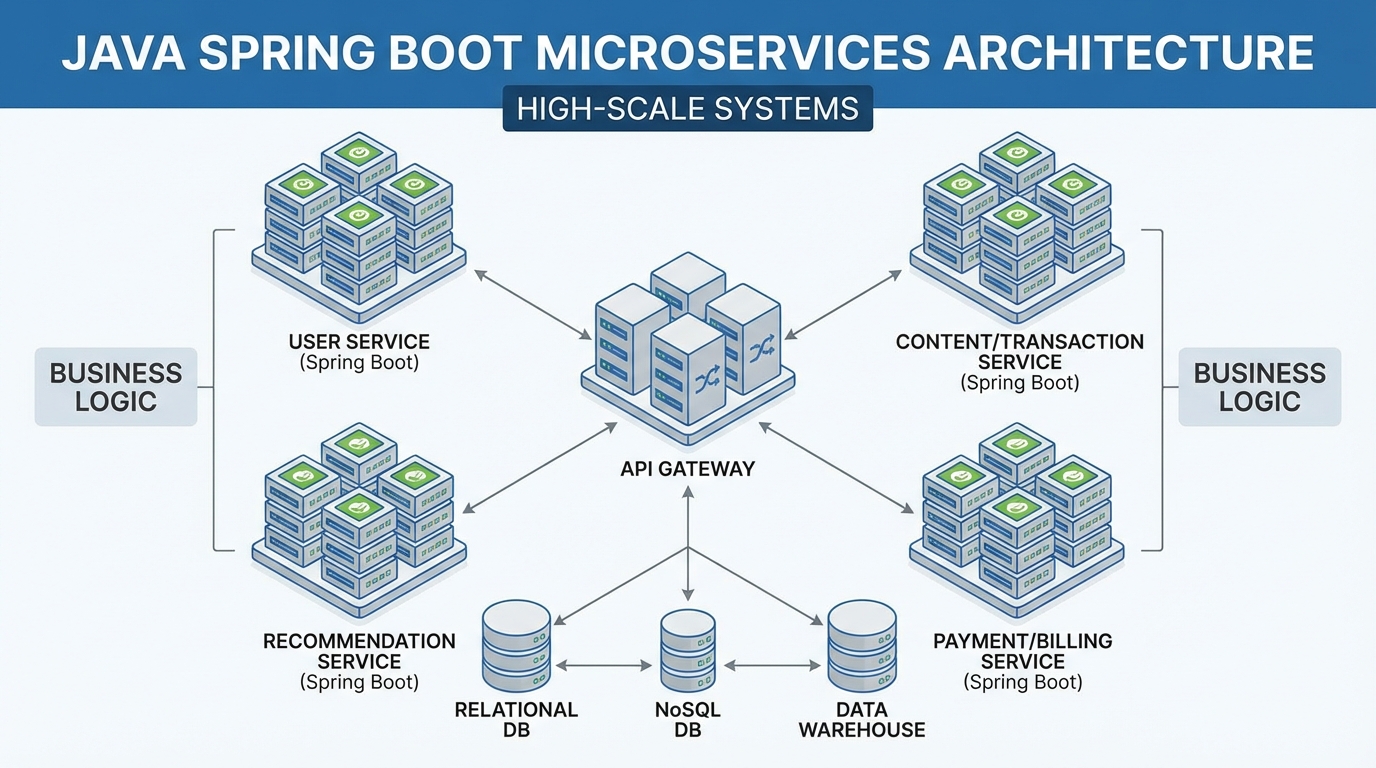
At number four is Java. People have been predicting the death of Java for a decade, yet it remains the backbone of the Fortune 500.
Who is this for?
- Backend Engineers: Building massive, scalable microservices.
- Enterprise Aspirants: Targeting banks (JP Morgan, Wells Fargo), Uber, Netflix, or Amazon.
The Data
- Market Dominance: While Python rules AI, Java rules Business Logic.
- Ecosystem: The Spring Boot ecosystem is unrivaled for rapid enterprise development.
Technical Deep Dive: The JVM and Modern Concurrency
Java runs on the Java Virtual Machine (JVM), a marvel of engineering. The Just-In-Time (JIT) compiler optimizes code as it runs, often making long-running Java applications faster than compiled C++ code in specific server scenarios due to runtime profiling.
The Evolution: Java isn’t stagnant. Recent versions introduced Virtual Threads (Project Loom). Previously, one Java thread equaled one OS thread (expensive). Now, Java can handle millions of lightweight virtual threads, rivaling Go’s goroutines and Node.js’s event loop for throughput.
Code Example: Spring Boot 3 & Virtual Threads This is what modern backend code looks like—declarative and highly scalable.
package com.example.demo;

import org.springframework.boot.SpringApplication;
import org.springframework.boot.autoconfigure.SpringBootApplication;
import org.springframework.web.bind.annotation.GetMapping;
import org.springframework.web.bind.annotation.RestController;
import java.util.concurrent.Executors;

@SpringBootApplication
@RestController
public class BankingService {

    public static void main(String[] args) {
        SpringApplication.run(BankingService.class, args);
    }

    @GetMapping("/process-transaction")
    public String process() {
        // In Java 21+, we can use Virtual Threads for high-throughput I/O
        try (var executor = Executors.newVirtualThreadPerTaskExecutor()) {
            executor.submit(() -> {
                // Simulate Database Latency
                Thread.sleep(100);
                System.out.println("Transaction processed by: " + Thread.currentThread());
            });
        } catch (Exception e) {
            return "Failed";
        }
        return "Transaction Queued";
    }
}
Career & Salary
Jobs in Java are massive in volume. If you know Spring Boot and Microservices architecture, you will never be unemployed. In India, salaries are comparable to Python but often offer more stability in traditional banking and finance sectors.
5. Rust: The Future of Systems Engineering
The Context
At number five, we have the challenger: Rust.
Who is this for?
- Intermediate/Senior Developers: (4-7 years experience).
- Performance Enthusiasts: Those who want C++ speed with memory safety guarantees.
The Data
- Adoption: Used in the Linux Kernel, Windows Kernel, and core tools like
uv(Python package manager) andswc(JS compiler). - Salary: While job volume is lower than Java/Python, the salary per job is significantly higher.
Technical Deep Dive: The Borrow Checker
Rust solves the biggest problem in C++: Memory Safety. In C++, you can accidentally access memory that has been freed (Use-After-Free), leading to crashes or security vulnerabilities.
Rust prevents this at compile time using the Borrow Checker. It introduces the concept of Ownership.
- Each value in Rust has a variable that’s called its owner.
- There can only be one owner at a time.
- When the owner goes out of scope, the value will be dropped.
Code Example: Fighting (and winning) against the Borrow Checker
use std::thread;
use std::sync::{Arc, Mutex};

fn main() {
    // Arc (Atomic Reference Counting) allows shared ownership across threads
    // Mutex allows safe mutability
    let counter = Arc::new(Mutex::new(0));
    let mut handles = vec![];

    for _ in 0..10 {
        let counter = Arc::clone(&counter);
        let handle = thread::spawn(move || {
            // Lock the mutex to get access to the data
            let mut num = counter.lock().unwrap();
            *num += 1;
        });
        handles.push(handle);
    }

    for handle in handles {
        handle.join().unwrap();
    }

    // In C++, doing this without race conditions is incredibly hard.
    // In Rust, the compiler REFUSES to build if you do it wrong.
    println!("Result: {}", *counter.lock().unwrap());
}
Career & Salary
Rust developers are rare. Supply is low, demand is high (especially in Silicon Valley and remote roles). If you master Rust, you are positioning yourself for top-tier engineering roles globally.
Honorable Mentions & Conclusion
While the top 5 are clear, we cannot ignore:
- C# (.NET): Still the king of Game Development (Unity) and strong in enterprise.
- Go (Golang): The language of the Cloud. Kubernetes and Docker are written in Go.
- Kotlin: The default for native Android development.
Final Verdict: Context is Everything
I will end this deep dive where I started. There is no “Best Language.”
- If you are building an AI startup: Python.
- If you are building a SaaS frontend: TypeScript.
- If you are writing a Game Engine: C++.
- If you are building a Banking API: Java.
- If you are building the next Browser Engine: Rust.
Real-world engineering limits your choices. Sometimes you join a company and have to write Java. Sometimes you inherit a legacy codebase in PHP. That is the reality.
However, if you have the luxury of time—if you are in your 20s, entering college, or looking to upskill—choose the tool that aligns with the problem you want to solve.
I hope this technical breakdown gives you the clarity to navigate 2026. Code is just a tool; what matters is what you build with it.
See you in the next commit.